In one sentence: the Sella descent is suitable for absolute beginners. Knowing how to swim is a legal requirement (kids included), but you don't need to be fit and you don't need to have ever touched a canoe. Life jacket compulsory, qualified instructor, stable unsinkable canoe, Grade I-II rapids (the gentlest there are) and minimum age 5 + 1.15 m. If it's your first time, come along relaxed: this article takes apart the eight typical worries one by one.
We've been taking families and friends down the Sella for over 25 years, and the question that comes up most the day before is always the same: "will I actually manage it?". The short answer is yes. The long one is this article.
The Sella descent isn't a sporting test or an extreme challenge. It's a paddle down a calm river in a canoe with six or seven slightly livelier stretches — the famous Grade I rapids, the gentlest of the six categories used in white water. Five-year-olds paddle it, so do seventy-year-old grandparents, and so do people who had never held a paddle in their life. And they all enjoy it.
If you're about to do it for the first time and a few doubts are spinning around your head, keep reading. We're going to take apart the eight most common beginner worries, one by one, with facts and no patronising.
Knowing how to swim is compulsory (it's a legal requirement · here's why)
This is the number one question and we'll answer it honestly: knowing how to swim is a legal requirement to paddle the Sella, kids included. It's not a recommendation of ours — it's required by the insurance companies and by the regulations of the Cantabrian Water Authority that governs the river.
The certified life jacket you wear throughout the activity — fitted to your size, compulsory, included in the price — is an aid, not a replacement. It keeps you afloat if you fall in, but knowing how to swim is what lets you stay calm, reach the bank if you need to, and enjoy the river without panicking. That's why both things go together: life jacket + knowing how to swim.
If anyone in your group is not a confident swimmer or has a real fear of water, our honest advice is to wait for another season and do a few pool sessions first. It's not a technical exam (being able to keep yourself afloat on your own for a few metres is enough), but it's non-negotiable. Better to come when you're ready than to regret it once you're on the water.
Knowing how to swim is a legal requirement for every participant (kids included) · certified life jacket included in the price · never taken off during the descent · fitted to each size before you set off.
The river does the work: it isn't an intense sport
Here's a truth that breaks the myth: the Sella practically paddles itself. The current does most of the work. You paddle gently to keep your line, dodge the odd rock and steer the canoe through a rapid. That's it.
It's not white-water kayaking. It's not a race. You don't need to train before coming. If you can walk for two or three hours at a steady pace, you can paddle the Sella without any trouble. In fact, most people come down in pairs or with the family and take turns on the paddle: one steers, the other rests, you chat as you go.
If you get tired halfway through, you stop. The river has six riverside bars dotted along the route where you can grab a drink, stretch your legs and get back on the water whenever you like. We talk about it below, and in depth in is the Sella descent tiring?.
Fitness required = being able to walk 2-3 hours at a relaxed pace. Not a kilometre more.
Grade I-II rapids: the gentlest category there is
In the white-water world, rapids are graded in six categories, from I to VI. Grade I is the gentlest of them all: small waves, clear current, no dangerous obstacles. Grade VI is what you see in YouTube clips of people dropping waterfalls in pro kayaks.
The Sella, on the stretch we paddle, is Grade I-II. No drops, no falls, no "right, hold on tight". The rapids are stretches where the water runs a bit quicker and forms small waves; the canoe handles them on its own and all you need to do is keep her pointing forwards. The feeling is fun, not frightening. There are no dangerous rapids on the tourist route.
To give you an idea: five-year-old kids paddle it. If there were any real danger, that age wouldn't be allowed. The minimum age (5 years old and 1.15 m tall) is set precisely because below those parameters the children's jacket no longer fits properly, not because of any technical difficulty on the river. If you'd like to see the highlights of the route one by one, you've got them on the interactive route map; and if one spot in particular catches your eye, we recommend reading about the Pozo del Arco, one of the most photogenic stops on the river.
Grade I-II out of VI · no drops · no falls · no technical rapids · suitable from age 5.
The canoe is unsinkable (and capsizes are very rare)
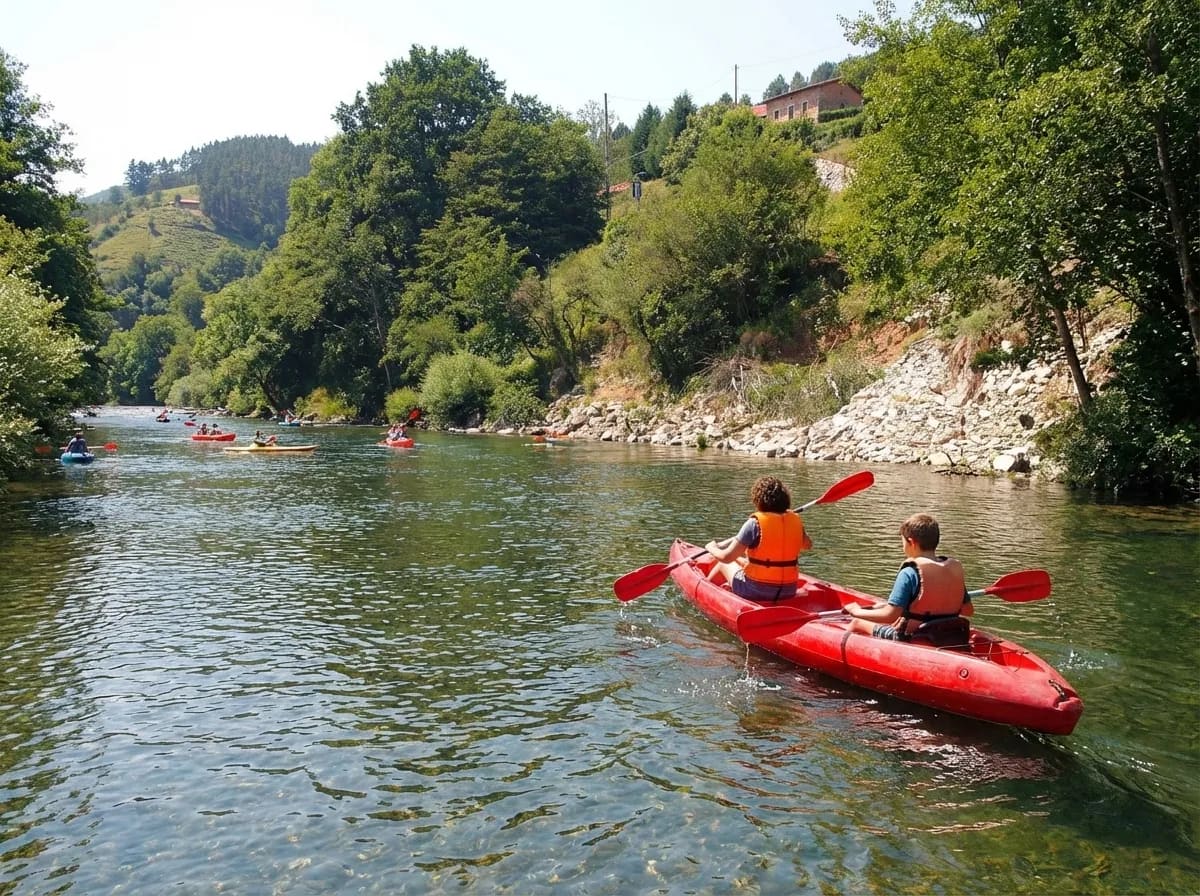
The canoe we use isn't a closed kayak. It's an open Canadian canoe made of polyethylene, wide, stable and with built-in buoyancy: even if it fills with water, it won't sink. It's the boat designed precisely for beginners and families. We also work with K3 canoes (up to 3 people) when there are three adults or two adults with a small child.
Can it capsize? Technically yes. Does it happen often? No. A tiny percentage of canoes capsize over the course of a season, and it's almost always because of a sudden movement when changing position or someone messing about. A normal descent doesn't involve a capsize.
And if it does happen, it's no big deal: you've got your life jacket on, it keeps you afloat automatically, the instructors are spread along the river in their own canoes and they pick you up in seconds. The canoe is recovered, the water tipped out and on you go. We've seen plenty of people end up roaring with laughter after a capsize; it's not the dramatic moment of the descent, it's an anecdote you tell fondly afterwards.
Open unsinkable canoe · instructors on the river at all times · capsize = anecdote, not emergency.
Stops at your own pace: the river has riverside bars
One of the things beginners love most about the Sella is that there's no obligation to paddle it in one go. The route has six riverside bars dotted along the river (Riverland, El Oasis, El Prau, El Bosque, La Mediana and Toraño) where you can stop for a drink, rest in the shade and get back on the water whenever you feel like it. You'll find them all in the riverside bars of the Sella descent.
If you're doing the Mini route (7 km · 2-3 hours), the stops are short: one rest and back on the water. If you're doing the Full (14.5 km · 4-5 hours), you can comfortably make two or three stops; many families stop to eat on a little beach (with the food you bring in the dry barrel) or at one of the riverside bars on the route and carry on afterwards. If you want the full breakdown of how long it takes with stops and how to work out your start time around the 18:00 river closure, we've got it in its own post.
And if once you're on the water you decide you'd rather not carry on? The Sella has intermediate exit points. You let the instructor know at a riverside bar, the van picks you up and takes you back to the starting point. Nobody is left stranded.
A five-minute short briefing and you've got the basics
Here's the difference between a serious company and one that just hires you a canoe: the short briefing beforehand. Before launching, a qualified instructor gathers you as a group, shows you how to hold the paddle (yes, the paddle), how to stroke on each side to turn, what to do when a rapid's coming up and how to reposition the canoe if it gets sideways.
It's five minutes, not a masterclass. But those five minutes are the difference between getting in the canoe relaxed and getting in with a "now what?" look on your face. If you'd like to picture the whole day beforehand, we lay out how to do the descent step by step, from check-in to disembarkation.
During the descent, the instructors aren't shut away in an office: they're spread along the river in their own canoes, keeping an eye on the key spots at the rapids and lending a hand if a canoe gets stuck or a group loses their bearings. If you'd like to meet the team, you'll find them in about us.
Short briefing on paddle technique and safety included · qualified instructor · present on the river throughout the descent.
To start out, we recommend the Mini route
We've got two routes and the answer for beginners is pretty clear:
- Mini route · 7 km · 2-3 hours · €25 kids (≤12) / €35 adults. The opening stretch of the descent, the gentlest and one of the prettiest scenery-wise. Passes through one or two Grade I rapids, plenty to get the experience without overdoing it. Just the right amount of time to enjoy it without ending up exhausted. This is the one we recommend as a first taste.
- Full · 14.5 km · 3-4 hours · same price by age. A better fit if you've paddled it before or if you're up for it and have the time. More stops, more river, more Grade I rapids spread out along the way.
Our honest recommendation: if it's your first time, do the Mini. If you finish wanting more, next year you can do the Full with the confidence of someone who knows the score. Better to finish wanting more than to finish wrecked, wishing it were over. We break it all down in how long the Sella descent takes.
Pets: they come down free with their canine life jacket. We cover it in Sella descent with kids (and more is coming). You can compare both routes in Sella descent prices.
Coming with kids? Minimum age and tips
Kids are the best customers on the Sella: nobody enjoys it more, and they paddle down completely safely as long as they meet the two basic requirements:
- 5 years old on the day of the descent.
- 1.15 m minimum height (needed so the children's life jacket fits properly).
Below that age/height it's not about the river: it's about the technical safety of the life jacket. Babies and children under 5 cannot do the descent.
Three tips for coming with small kids:
- Do the Mini. Three hours in a canoe is the comfortable limit for a 5-7 year old; the Full feels long for them.
- Lunch halfway down. Bring a sandwich and water in the dry barrel or stop to eat at one of the riverside bars on the route.
- Sun cream and a hat with a chin cord. Kids get wetter and burn quicker.
If you're coming with little ones, we also recommend reading Sella descent with small kids (an honest guide with the typical worries) and the cluster page Sella descent with kids.
When to come if it's your first time
For beginners, there are two variables worth getting right: the time of year and the time of day. The quieter the river and the better the water level, the more comfortable and beautiful the experience is.
- Best time of year. June and September are the standout months for first-timers: stable weather, comfortable water level and far less crowding than August. We cover it in best time for the Sella descent.
- Best time of day. Arriving in the Premium window 10:30-12:30 (open window, no fixed time) puts you on the water with fewer canoes around and better light for photos. We unpack it in best time of day to paddle the Sella.
- River closing time. The Sella closes at 18:00 by order of the Cantabrian Water Authority. If you want to do the Full, don't set off later than 13:00.
And if you'd like to get to know the legend of the river beyond your first descent, take a look at history of the Sella descent and the International Sella Descent festival, held every first Saturday of August.
Quick summary: what to remember before you come
If you've made it this far, you already know that the Sella descent doesn't require experience or fitness, but it does require knowing how to swim (it's the law, kids included). Compulsory life jacket, qualified instructor for the short briefing, stable polyethylene open Canadian canoe and Grade I-II rapids (the gentlest there are). Minimum age 5 and 1.15 m. We recommend the Mini route to start with.
The only thing left for you to do now:
- Book ahead (strongly recommended). The Sella fills up in summer; with your spot confirmed you come along relaxed. If you've got a free day and you ask us about availability for today, we check the calendar and let you know. Booking is always done by web, WhatsApp, phone or email — we don't take walk-ins at the office.
- Bring clothes that can get wet, closed shoes and sun cream. Full list in what to bring to the Sella descent.
- If you're coming with a dog or with small kids, let us know when you book and we'll get it ready.
- If you're travelling from far, take a look at Sella descent from Arriondas for the start-point detail.
Paddling the Sella for the first time isn't an exam or a challenge. It's a day on the river in Asturias with the canoe brought to you, the instructor showing you the ropes and the bus picking you up. All you have to do is turn up.
For big groups or stag and hen dos, we recommend Sella descent for groups and stag dos. If you want to make a longer day of it, in what to do after the descent in Ribadesella and where to stay near the descent you've got the full plan. For premium experiences (open window, private changing rooms, lockers), there's Premium booking. And if you'd like to see what other first-timers say, there are 276 real reviews on reviews with a 4.5★ average.
In 25 years we've seen all sorts paddle the Sella: grandparents who hadn't been in the water since their honeymoon, kids who fell asleep in the canoe, hen parties who sang their way down the whole river and couples who came for the first time and came back three years in a row. The important thing is that you come along relaxed: the rest we sort out. For any extra questions, drop us a line via contact.
What you ask us most
- Do you need to know how to swim to do the Sella descent?
Yes. Knowing how to swim is a legal requirement for every participant, kids included. The life jacket is a certified aid you wear throughout the activity, but it does not replace being able to swim. If anyone in your group is not a confident swimmer or feels uneasy around water, it is better to wait until another season or have a few pool sessions first. We go into this more in Sella descent with kids.
- Do you need to be fit to paddle the Sella?
No. The Sella practically paddles itself: the current does most of the work and you paddle gently to keep your line. The fitness required is about the same as being able to walk for 2-3 hours at a relaxed pace. It is not an intense sport or a race. Most people come down in pairs or with the family and take turns on the paddle.
- Is it dangerous? How tough are the Sella rapids?
The Sella rapids are Grade I-II out of VI — the gentlest category of white water there is. There are no drops or scary falls: they are stretches where the water runs a little faster and forms small waves. The minimum age is 5 precisely because the river is suitable for everyone with the right kit. We see grandparents in their 70s and kids who had never picked up a paddle paddling down with a grin.
- What if I capsize the canoe? Does it happen often?
Capsizing is very rare. The canoe we use is an open Canadian canoe made of polyethylene, wide and stable, with its own buoyancy (it will not sink even if it fills with water). If it does happen, the life jacket keeps you afloat automatically and our qualified instructors are spread along the river in their own canoes and pick you up in seconds. We have seen plenty of people end up laughing their heads off after a capsize.
- Mini or Full route for a first time?
For a first time we recommend the Mini route: 7 km, 2-3 hours, enough Grade I rapids to live the experience and just the right amount of time to enjoy it without ending up exhausted. The Full route (14.5 km · 3-4 hours) is a better fit if you have done it before or have the whole day and plenty of energy. Better to finish wanting more than to finish wrecked, wishing it were over.
- What is the minimum age for the Sella descent?
5 years old and 1.15 m minimum height. It is not because of the river — it is because below those parameters the children's life jacket does not fit properly. Babies and children under 5 cannot do the descent. We cover this in more detail in Sella descent with kids.
- Do you have to book ahead, or can you turn up on the day?
Booking ahead is strongly recommended, especially in July, August and bank holidays. In May, June or September we usually have spots available on the day, but it is worth confirming. Booking is done online, by WhatsApp, phone or email — we don't take walk-ins at the office because we want to make sure we have a canoe and an instructor for you. If you want to come the same day and you give us a shout, we check the calendar and let you know.

